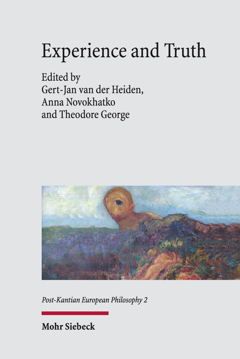
This volume brings together a range of internationally respected scholars to examine a distinctively hermeneutical conception of truth, one that is born from experience and grows from our shared interpretive encounters with one another, texts, art, and the world.
The concern of this volume is to advance research in philosophical hermeneutics on the theme of »experience and truth.« Brought into focus by this theme is a sense of truth wed to, even bound by, what we may come to understand through our experience of the world, ultimately, though what ancient Greek philosophers first described as perception (αἴσθησις). Such a sense of truth may be called 'this-worldy' truth insofar as it delimits the scope and possibilities of knowledge for beings whose experience of the world is bound by perception. Often, we associate this sense of truth with philosophical traditions of, say, empiricism, as in figures such as Francis Bacon; or, with celebrated figures in the tradition of materialism, such as Lucretius. The impetus for this volume, however, is that Gadamer's philosophical hermeneutics offers an important source for the consideration of this-worldly truth. Distinctive of Gadamer's hermeneutics is that this sense of truth cannot be guaranteed by pre-established norms, methods, or techniques but rather results always from the interpretation of texts, artworks, and our shared experience of the world. The contributors to this volume examine the hermeneutics of the relation of truth and experience in conversation not only with contemporary scholarship in a range of fields, but also, among other things, figures in the history of philosophy, artists and their artworks, and the testimony of others who have borne witness to things we otherwise remain ignorant.
Table of contents:
Gert-Jan van der Heiden,
Anna Novokhatko und
Theodore George: Introduction: Hermeneutic Truth as Truth that is Bound by Experience -
Theodore George: Our Humanity is Not Measured in Words: Toward a Post-Gadamerian Hermeneutics of the Impossibility to Converse -
Cynthia R. Nielsen: Hermeneutics, Language, and the Language of War -
Carolyn Culbertson: Hermeneutic Virtue and the Event of Truth -
Haley Irene Burke: Realisms and the Problem of Freedom: A Phenomenological Solution -
Antonia Egel: In a Room Filled with Beautiful Things: Aesthetic Education Reconsidered from the Perspective of Spatial Phenomenology -
James Risser: The Understanding of What is Understood -
Alejandro Vallega: Notes Towards the Art of Poetic Thinking -
Elena Romagnoli: From
Darstellung to
Vollzug: At the Convergence of Art and Language in Gadamer's Hermeneutics -
Anna Novokhatko: Civic Truth and the Spectatorial Polis in Greek Tragedy -
Gert-Jan van der Heiden: What Does it Mean to Be a Spectator? -
Antonia Egel: »Nicht Zeit-Raum hat die Kunst« / »Not Time-Art Has Space«