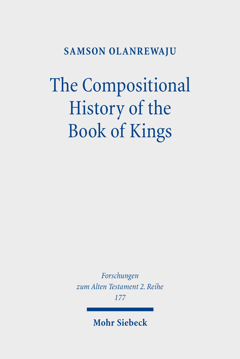
How did the book of Kings come to have its present shape? Samson Olanrewaju examines the formulas used to evaluate each Israelite and Judean king and argues that their variations reflect the work of successive scribes, from the ninth century BCE through the post-exilic period. The result is a new, stratified model of the composition of Kings.
Samson Olanrewaju investigates the composition of the book of Kings through an analysis of the formal regnal evaluations of Israelite and Judean kings found in 1 Kgs 14-2 Kgs 25*. Using source- and redaction-critical approaches, he postulates that the earliest edition of the book of Kings (Kings Edition0), commissioned by Amaziah's court in early eighth-century Judah, documents the reigns of Judean kings from Rehoboam through Jehoash ben Ahaziah. Kings Edition0 was subsequently updated with the accounts and evaluations of Amaziah, Uzziah, Jotham, Ahaz, and Hezekiah, resulting in Kings Edition1.
Kings Edition1, a document produced by pro-Assyrian groups operating within Manasseh's court in seventh-century Judah, retained the Judah-centric orientation of its predecessor (Kings Edition0), concentrating on the reigns of Jehoash ben Ahaziah's successors rather than on synchronized lists of Judean and Israelite rulers. Such synchronizations were introduced in Kings Edition2, a sixth-century Deuteronomistic edition of the book of Kings produced by an exilic editor who was also responsible for the regnal evaluations of Manasseh, Amon, Josiah, Jehoahaz, and Jehoiakim as well as the northern entries of Nadab, Baasha, Omri, and Ahaziah.
Furthermore, the polemical references to idolatrous Judean bamot found in the regnal evaluations of »good« Judean kings are attributable to the Deuteronomistic editor of Kings Edition2. This early exilic edition of Kings subsequently evolved into Kings Edition3 through revisions and expansions undertaken by late/post-exilic redactors, who incorporated the northern entries of Jehoash, Jeroboam II, Zechariah, Menahem, Pekahiah, and Pekah as well as the southern entries of Abijam, Jehoiachin, and Zedekiah.
Table of contents:
Chapter 1: Introduction and Methodology
1.1. Previous Models
1.2. Methodology
Chapter 2: Southern Regnal Evaluations (I): 1 Kgs 14:22-2 Kgs 18*
2.1. Southern Pattern 0 (SP0): Rehoboam, Asa, Jehoshaphat, Jehoram ben Jehoshaphat, and Ahaziah ben Jehoram, and Jehoash ben Ahaziah
2.2. Southern Pattern 1 (SP1): Amaziah, Azariah/Uzziah, Jotham, and Hezekiah
Chapter 3: The Bamot Theme(s) in 1 Kgs 14:22-2 Kgs 18*
3.1. History of Research
3.2. Analysis of Bamot Texts
3.3. Synthesis of 2 Kgs 18:4-8 and Bamot Theme
Chapter 4: Southern Regnal Evaluations (II)
4.1. Southern Pattern 2 (SP2): Manasseh (2 Kgs 21:2)
4.2. Amon (2 Kgs 21:20-22)
4.3. Southern Pattern 3 (SP3): Josiah
4.4. Southern Pattern 4 (SP4): Jehoahaz ben Josiah and Jehoiakim
4.5. Special Case: Abijam/Abijah (1 Kgs 15:3)
4.6. Synthesis of Judean Regnal Evaluations
Chapter 5: Northern Regnal Evaluations
5.1. Introduction
5.2. Northern Pattern C (NPC): Jehoash, Jeroboam II, Zechariah, Menahem, Pekahiah, and Pekah
5.3. Northern Pattern B (NPB): Nadab, Baasha, Omri, and Ahaziah ben Ahab
5.4. Northern Pattern A (NPA): Ahab (1 Kgs 16:30)
5.5. Special Northern Cases: Jehu (2 Kgs 10:29-31), Jehoahaz ben Jehu (2 Kgs 13:2), Jehoram ben Ahab (2 Kgs 3:2-3), and Hosea (2 Kgs 17:2)
5.6. Synthesis of Northern Frameworks
Chapter 6: The Literary Growth of 1 Kgs 12:26-13:34 (Case Study)
Introduction
6.1. History of Research on 1 Kgs 12:26-13:34
6.2. Textual Notes: 1 Kgs 12:26-13:34
6.3. Analysis of 1 Kgs 12:26-13:34
6.4. Synthesis of 1 Kgs 12:26-13:34
Chapter 7: Conclusion: A New Model
7.1. The Evaluative Frameworks in the Book of Kings
7.2. The Compositional History of the Book of Kings: A New Model
7.3. Closing Remark